
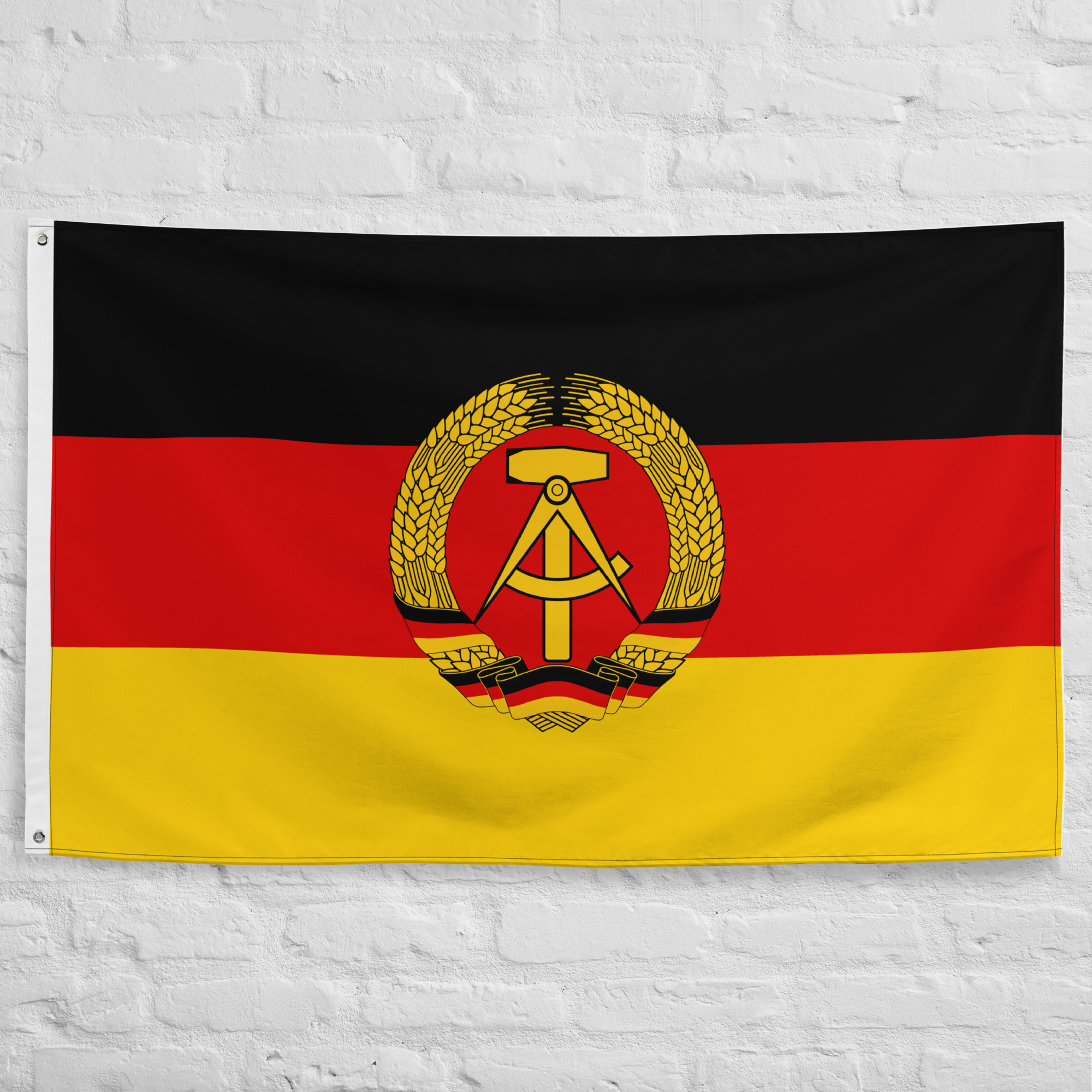
East Germany Flag – Symbol of the German Democratic Republic
The East Germany Flag represents one of the most significant states of the Cold War era. Featuring the traditional black, red, and gold German tricolor combined with the distinctive national emblem of the German Democratic Republic, this historic banner symbolizes more than four decades of East German history between 1949 and 1990.
Known internationally as the GDR, the German Democratic Republic existed as the socialist state occupying the eastern portion of Germany following the Second World War. The East Germany Flag became an instantly recognizable symbol throughout Europe and the wider world during a period marked by political rivalry, ideological competition, and global tension.
Today, the East Germany Flag remains popular among historians, collectors, political history enthusiasts, Cold War researchers, and individuals interested in twentieth-century European history.
The History of the German Democratic Republic Flag
Following the division of Germany after World War II, two separate German states emerged. In the west stood the Federal Republic of Germany, commonly known as West Germany, while the Soviet occupation zone evolved into the German Democratic Republic in 1949.
Initially, both German states used similar black, red, and gold tricolors. However, in 1959, East Germany introduced a unique national emblem to distinguish its banner from that of West Germany. This emblem featured a hammer and compass surrounded by a wreath of grain, creating the design recognized today as the GDR Flag.
The hammer symbolized industrial workers, the compass represented intellectuals and technical professions, and the grain wreath reflected agricultural workers. Together, these elements were intended to symbolize the unity of different sectors of socialist society.
For more than thirty years, the German Democratic Republic Flag flew over government buildings, military installations, schools, embassies, sporting events, and public institutions throughout East Germany.
Cold War Germany and the DDR Flag
The DDR Flag became closely associated with one of the defining geopolitical conflicts of the twentieth century. During the Cold War, East Germany occupied a strategically important position between the Soviet Union and Western Europe.
The country became one of the most visible members of the Eastern Bloc and played a major role in the political landscape of postwar Europe. The construction of the Berlin Wall in 1961 further reinforced the division between East and West Germany, making the East Germany Flag a symbol recognized around the world.
Throughout this period, East Germany developed its own political institutions, military forces, educational systems, economic policies, and international relationships. The national banner became an important representation of state identity during a time of rapid global change.
Following the peaceful revolutions of 1989 and the collapse of communist governments across Eastern Europe, German reunification took place in 1990, bringing an end to the German Democratic Republic.
Meaning and Symbolism of the GDR Emblem
The most distinctive feature of the GDR Flag is its central emblem. Unlike many historical banners that rely primarily on heraldic imagery, the East Germany Flag used modern symbolism reflecting the state’s political and social ideals.
The hammer represented factory workers and industrial production. The compass symbolized scientists, engineers, teachers, and intellectual professions. Surrounding both elements, the wreath of grain reflected the importance of agriculture and rural communities.
This combination created one of the most recognizable national emblems of the Cold War period and helped distinguish the East German Banner from other historical German flags.
East German Banner for Collectors and Historical Displays
Whether displayed in a home, office, classroom, museum-style collection, or educational setting, the East German Banner offers a fascinating connection to twentieth-century history.
Collectors frequently include the East Germany Flag alongside other historical banners from the Cold War era, including those associated with the Soviet Union, Warsaw Pact nations, NATO countries, and former socialist states of Eastern Europe.
The flag is also popular among enthusiasts of German history, military history, political science, European studies, and modern historical research. Its distinctive emblem and historical significance make it one of the most recognizable flags of the twentieth century.
Historical Legacy of East Germany
Although the German Democratic Republic no longer exists, its history continues to influence discussions about postwar Europe, German reunification, Cold War politics, and the transformation of Eastern Europe after 1989.
Today, the East Germany Flag serves as a reminder of a unique chapter in German history. Whether appreciated as a historical artifact, educational tool, or collector’s piece, it remains an important symbol of one of the most influential periods of the modern era.
Browse Our Collection
Browse our collection of Historical Flags to discover more Cold War, military, political, and heritage-inspired banners from around the world.
Product Features
- 100% polyester construction
- Durable knitted fabric
- Printed on one side
- Blank reverse side
- 2 iron grommets for easy display
- Suitable for indoor and outdoor use
Reviews
There are no reviews yet.